





The 1% Problem: What You Should Know About Collagen Loss After 30
by Parallel Health Team
Your skin ages quickly after a certain age. Here's the science—and what you can do about it.
There's a number that doesn't get talked about enough in skincare: one percent.
Starting in your mid-to-late twenties, your body's ability to produce collagen—the protein responsible for skin firmness, elasticity, and structure—begins to decline by approximately 1-1.5% per year. By the time you reach 50, you may have lost nearly 35% of your skin's collagen content. And unlike the visible signs of aging we obsess over (fine lines, wrinkles, sagging), this loss happens silently, beneath the surface, for years before it becomes apparent.
This is The 1% Problem. Understanding it is the first step toward doing something about it.
The Biology of Collagen Decline
Collagen is the most abundant protein in your body, comprising roughly 75-80% of your skin's dry weight. It provides the scaffolding that keeps skin firm and resilient. But collagen isn't static; it's in a constant state of turnover, with old fibers breaking down and new ones being synthesized.
The issue is that this balance shifts as we age. Research published in the Journal of Cosmetic Dermatology demonstrates that collagen synthesis decreases progressively after the second and third decades of life, while collagen-degrading enzymes (called matrix metalloproteinases, or MMPs) increase. The result is a net loss that compounds year over year.
For women, this decline accelerates dramatically during perimenopause and menopause, with some studies showing up to an additional 30% collagen loss in the first five years post-menopause alone.
Why Traditional Skincare Falls Short
Most "anti-aging" products focus on surface hydration or temporary plumping effects. While these approaches have their place, they don't address the underlying biology of collagen loss.
To meaningfully support collagen production, you need ingredients that can communicate with skin cells at a deeper level—signaling fibroblasts (the cells responsible for collagen synthesis) to increase production, while simultaneously protecting existing collagen from degradation.
This is where peptides become essential.
The Peptide Approach to Skin Longevity
Peptides are short chains of amino acids that function as cellular messengers. Different peptides send different signals, and when formulated correctly, they can orchestrate a comprehensive response to age-related collagen decline.
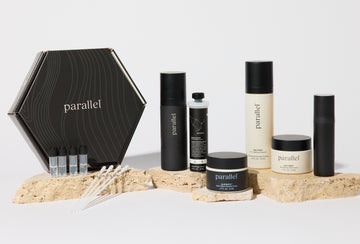
The Blue Biotic™ Multi-Effect Peptide Cream contains five clinical-grade peptides, each selected for a specific mechanism of action:
Acetyl Hexapeptide-8 (SNAP-8): Often called "Botox in a jar," this expression-smoothing peptide has been clinically shown to reduce wrinkle depth by 63% in 28 days by modulating neurotransmitter release at the neuromuscular junction.
Copper Tripeptide-1 (GHK-Cu): One of the most extensively researched peptides in dermatology, GHK-Cu promotes collagen synthesis, accelerates wound healing by up to 70%, and has been shown to activate over 4,000 genes associated with tissue repair and regeneration.
Palmitoyl Tripeptide-1 & Palmitoyl Tetrapeptide-7 (Matrixyl 3000): This synergistic combination stimulates collagen I, III, and IV production while reducing inflammatory cytokines that contribute to collagen breakdown.
Palmitoyl Tripeptide-38 (Matrixyl Synthe'6): Stimulates six major components of the skin matrix, including collagen and hyaluronic acid, to support comprehensive dermal restructuring.
A Systems Approach to Skin Health
What distinguishes effective peptide formulations from marketing claims is concentration, delivery, and supporting ingredients. Peptides require an optimized environment to function—adequate hydration, antioxidant protection, and barrier support.
The Blue Biotic™ formula includes 34 active ingredients designed to create this environment: powerhouse peptides for skin longevity, niacinamide for barrier function and pigmentation, beta-glucan for immune modulation and wound healing, creatine for cellular energy, and prebiotic ferment filtrates to support the skin microbiome.
This systems-level approach reflects a fundamental shift in how we think about skincare—from treating symptoms to supporting the underlying biology of healthy skin.
The Long View
Skin longevity isn't about fighting time. It's about understanding the biological processes that drive aging and providing your skin with the tools it needs to function optimally, for longer.
The 1% Problem isn't going away. But armed with the right science, you can change the trajectory.
FAQs
At what age does collagen loss actually begin? Research indicates collagen production begins declining in the mid-to-late twenties, with measurable losses of approximately 1-1.5% per year becoming evident by age 30.
Can topical products really increase collagen production? Yes. Certain peptides, particularly Copper Tripeptide-1 (GHK-Cu), have been shown in clinical studies to stimulate collagen synthesis at rates superior to vitamin C and comparable to retinoids, without the irritation profile.
How long does it take to see results from peptide skincare? Clinical studies on SNAP-8 (Acetyl Hexapeptide-8) demonstrated 63% wrinkle reduction in 28 days. However, comprehensive improvements in skin density and firmness typically require 8-12 weeks of consistent use.
Is Blue Biotic™ suitable for sensitive skin? The formula was designed with microbiome compatibility in mind, using gentle prebiotic ingredients and avoiding common irritants. However, as with any new skincare product, patch testing is recommended.
Can I use Blue Biotic™ with retinol or other actives? Yes. Because of the Blue Biotic™ unique, bioavailable formulation, the peptides in Blue Biotic™ are compatible with most skincare actives, including retinoids and vitamin C. For optimal results, apply Blue Biotic™ as the final step in your evening routine. When using with your Custom Compounded Prescription with tretinoin, the Blue Biotic™ can be applied before and after (the "sandwich" method).
Is the product HSA/FSA eligible? Yes, Blue Biotic™ Multi-Effect Peptide Cream qualifies for HSA/FSA reimbursement.
Scientific References
- Sibilla, S., Godfrey, M., Brewer, S., Budh-Raja, A., & Genovese, L. (2015). An overview of the beneficial effects of hydrolysed collagen as a nutraceutical on skin properties: Scientific background and clinical studies. The Open Nutraceuticals Journal, 8(1), 29-42.
- Varani, J., Dame, M. K., Rittie, L., Fligiel, S. E., Kang, S., Fisher, G. J., & Voorhees, J. J. (2006). Decreased collagen production in chronologically aged skin: roles of age-dependent alteration in fibroblast function and defective mechanical stimulation. The American Journal of Pathology, 168(6), 1861-1868.
- Pickart, L., Vasquez-Soltero, J. M., & Margolina, A. (2015). GHK peptide as a natural modulator of multiple cellular pathways in skin regeneration. BioMed Research International, 2015, 648108.
- Blanes-Mira, C., Clemente, J., Jodas, G., Gil, A., Fernández-Ballester, G., Ponsati, B., ... & Ferrer-Montiel, A. (2002). A synthetic hexapeptide (Argireline) with antiwrinkle activity. International Journal of Cosmetic Science, 24(5), 303-310.
- Naughton, G., Mansbridge, J., & Gentzkow, G. (1997). A metabolically active human dermal replacement for the treatment of diabetic foot ulcers. Artificial Organs, 21(11), 1203-1210.
- Ganceviciene, R., Liakou, A. I., Theodoridis, A., Makrantonaki, E., & Zouboulis, C. C. (2012). Skin anti-aging strategies. Dermato-Endocrinology, 4(3), 308-319.
The Blue Biotic™ Multi-Effect Peptide Cream is available at parallelhealth.io. Founded by MDs and PhDs, Parallel Health is pioneering Microbiome Dermatology™ to deliver science-backed solutions for skin longevity.