







Your Skin Has a Biological Age, and It's Not the Same as Your Birthday
You probably know your age in years. But your skin has a second clock running at the microbial level, and it may be telling a very different story.
Recent research published in Frontiers in Aging (2025) confirmed that the skin microbiome is an accurate predictor of chronological age, outperforming even the gut and oral microbiomes as an aging biomarker (Swaney et al., 2025). In other words, the bacteria living on your face right now carry a measurable signature of how old your skin is–not just cosmetically, but biologically.
What Changes in the Aging Skin Microbiome
Young, healthy skin is dominated by Cutibacterium acnes, the same bacterium that most people associate with acne, but which in healthy populations plays a critical role in producing antimicrobial peptides, regulating skin pH, and supporting the barrier. As skin ages, Cutibacterium declines sharply. In its place, populations of Staphylococcus and Corynebacterium species expand. These shifts don't just correlate with age; they actively drive it. The loss of beneficial commensals leads to reduced ceramide synthesis, weakened barrier function, elevated transepidermal water loss (TEWL), and a smoldering inflammatory state known as inflammaging (Challa et al., 2025, Int J Mol Sci).
Why "Biological Age" Matters More Than Wrinkle Count
Traditional anti-aging metrics focus on what you see: lines, texture, pigmentation. But by the time these appear, the underlying biology has been changing for years. Microbial biological age captures what's happening beneath the surface i.e. the state of your barrier, your immune-microbiome crosstalk, your skin's capacity to repair itself. This is why two people of the same chronological age can have dramatically different skin biological ages: lifestyle, stress, diet, skincare habits, and geography all shape the microbial ecology in ways that translate into real differences in how skin ages.
Can You Actually Measure Your Skin's Biological Age?
Yes, but only with whole-genome shotgun metagenomics, not the 16S rRNA amplicon sequencing used by most commercial microbiome tests. Standard 16S reads identify broad taxonomic groups; shotgun metagenomics resolves species-level and even strain-level microbial signatures, including the functional genes those microbes carry. This resolution is what makes biological age prediction possible.
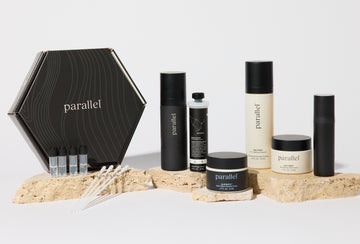
Parallel Health's Skin Discovery Test, included in the MD-03 Protocol™, uses quantitative shotgun metagenomics to characterize your skin's microbial ecosystem at the species level. This proprietary test maps which bacteria are present, at what absolute abundances, and what metabolic functions they're performing. The resulting Skin Health Report and Quantitative Microbial Analysis™ translates this data into actionable clinical insights that inform your personalized protocol.
The Path Forward: Test, Treat, Track
Because microbial biological age is dynamic, not fixed, it can be shifted. Clinical evidence shows that targeted microbiome interventions using precision probiotics, postbiotics, and phage-based formulations can restore beneficial bacterial populations, reduce inflammaging signals, and recalibrate the skin's microbial ecology toward a younger state (Challa et al., 2025). But effective intervention requires knowing your baseline.
The MD-03 Protocol™ begins with a Skin Discovery Test, followed by a 1:1 medical consultation with a board-certified provider who reviews your Skin Health Report and designs a precision protocol, which may include a Custom Active Phage Serum, Custom Compounded Prescription, and/or targeted cosmeceuticals — specific to your microbial profile. Complimentary retesting every six months enables tracking of your microbiome trajectory, confirming whether your skin's biological age is improving.
→ Take the Skin Discovery Test
→ Start MD-03 Protocol™ (Skin Discovery Testing Included)
Frequently Asked Questions
Q: How is skin microbiome age different from epigenetic skin age?
A: Epigenetic clocks (like GrimAge) measure DNA methylation patterns in skin cells. Microbial biological age measures the community composition and functional state of the microorganisms living on your skin. Both are valid aging biomarkers and can diverge e.g. your epigenetic age might look younger while your microbiome has aged significantly, or vice versa.
Q: Can a probiotic moisturizer change my skin's biological age?
A: Generic probiotic moisturizers contain standardized strains may colonize your skin ecosystem and shift its trajectory meaningfully. However, without knowing your individual microbial baseline, it's hard to say for sure. Precision intervention, matched to your specific microbiome, is what drives measurable change.
Q: How often should I retest my skin microbiome?
A: For most people, retesting every six months captures meaningful change while accounting for seasonal variation. MD-03 Protocol™ members receive complimentary retesting at six-month intervals as part of their membership.
Q: Does the skin microbiome age the same way in all skin types and ethnicities?
A: No. Research confirms that microbial aging patterns show significant individual variability influenced by demographics, physical environment, partners, family household, pets, and genetics. Because we are all unique, personalization is the most scientifically sound approach to optimizing your skin microbiome and skin age.
References
- Swaney, D.J., Newman, D., Mao, M., Hilton, A.C., Worthington, R.J., & Li, J. (2025). Aging-dependent skin microbiome alterations across body sites in a United Kingdom cohort. Frontiers in Aging, 6, 1644012. https://doi.org/10.3389/fragi.2025.1644012
- Challa, V., Prajapati, S.K., Gangani, S., Yadav, D., Lekkala, L., Jain, S., & Yadav, H. (2025). Microbiome–Aging–Wrinkles Axis of Skin: Molecular Insights and Microbial Interventions. International Journal of Molecular Sciences, 26(20), 10022. https://doi.org/10.3390/ijms26200 10022
- Howard, B.M., et al. (2022). Age-related changes in the skin microbiome: a systematic review. Referenced via PMC Microbiome Aging Review compilation.