







The Complete Anti-Aging Regimen: Test First, Then Treat // Microbiome Testing, Compounded Rx, Peptides, and Phage Therapy
Most anti-aging routines are built backward. People buy a serum because it's trending, add a retinol because an influencer mentioned it, and hope for the best. None of it is calibrated to what's actually happening in and on their skin.
A more precise approach starts with data, not product. Skin microbiome testing establishes a baseline and answers the questions: What is your skin's biological age? How much inflammaging is present? Which microbial and biochemical drivers are accelerating collagen loss right now? Only once that baseline exists does it make sense to layer in treatment — custom compounded prescription actives, clinically validated peptides, and, increasingly, phage therapy targeted at the specific bacteria driving inflammation in that person's skin. This is the model Parallel Health uses in its Microbiome Dermatology™ practice, and it's worth understanding why testing is so crucial and how each treatment layer works once you know what you're treating.
Why one product can't fix all of your skin aging problems
Skin aging is driven by several independent processes running at once. Parallel Health frames these as the 7 Hallmarks of Skin Aging™: loss of elasticity, collagen loss, volume loss, inflammation, dryness, uneven skin texture, and dyspigmentation. Three of these are the ones a precision anti-aging regimen has to address first, because they compound the other four:
- Collagen loss, largely due to UV-driven upregulation of matrix metalloproteinases (MMPs) that break down existing collagen faster than fibroblasts can replace it. This same MMP activity also drives loss of elasticity, since collagen and elastin form the structural scaffolding that keeps skin firm.
- Inflammation — specifically inflammaging, the chronic, low-grade inflammatory state that intensifies with age and is now understood to be closely tied to shifts in the skin's microbial ecosystem, not just the gut's. Inflammaging is a root driver, not just one hallmark among seven: it accelerates collagen breakdown, worsens dryness by impairing barrier function, and contributes to uneven skin texture.
- Microbial dysbiosis, where a younger skin ecosystem shifts toward higher diversity and different species associated with barrier disruption and impaired skin function. This isn't one of the seven hallmarks on its own, but it's a major upstream cause of inflammation, dryness, and texture changes, which is why testing the microbiome directly (rather than only treating what's visible) matters.
A generic moisturizer or serum can address one of these, at best, and usually at a low concentration with limited penetration. Treating all three requires a clinical, multi-pronged approach. But no product can be prescribed intelligently without first knowing which processes are actually driving a given person's aging. That's why testing comes first.
Step one: skin microbiome testing establishes the baseline
Skin aging isn't uniform, and neither is its cause. Two people with the same visible wrinkles can have very different underlying biology: one driven mostly by UV-related collagen breakdown, another by microbial dysbiosis and inflammaging. Without testing, you are guessing at which one applies, and a generic regimen will only address one of them at best.
Research increasingly shows that the skin microbiome is a stronger predictor of chronological age than the gut or oral microbiome. As skin ages, microbial diversity increases, Cutibacterium acnes declines, and Corynebacterium and Streptococcus populations expand — a shift closely tied to barrier disruption, oxidative stress, and inflammaging.
Most commercial microbiome tests rely on 16S rRNA sequencing, which identifies broad bacterial groups but misses species-level detail, fungi, viruses (including bacteriophages), and the functional genes microbes are actually expressing. Whole-genome shotgun metagenomics resolves microbial ecosystems down to the species and strain level, which is what allows a lab to calculate an actual skin biological age, a measure of inflammaging, and a rate-of-aging trajectory, rather than a generic "your skin has bacteria" report.
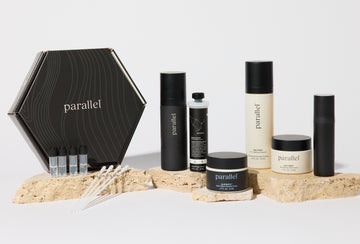
Parallel Health's Skin Discovery Test™, part of its MD-03 Protocol™, uses this shotgun metagenomic approach, drawing on a proprietary reference library of 10,000+ characterized microbial strains (roughly 90% of them novel) to generate a Quantitative Microbial Analysis™ and Skin Health Report. This data, not a generic intake form, is what determines which of the treatments below actually apply to a given person, and in what combination.
Step two: build the regimen around what the test shows
Once biological age, inflammaging level, and the specific microbial and biochemical drivers are known, treatment can be matched to the finding instead of applied as a blanket protocol. Three tools cover the mechanisms most often responsible for accelerated aging: prescription actives for collagen turnover, peptides for signaling and enzyme inhibition, and phage therapy for microbial dysbiosis driving inflammaging directly.
Custom compounded prescription actives
Topical tretinoin (all-trans-retinoic acid) remains the most rigorously studied anti-aging active in dermatology. In a landmark clinical trial, patients with photodamaged skin treated daily with 0.1% tretinoin cream for 10 to 12 months showed an 80% increase in new collagen I formation, compared with a 14% decrease in the vehicle-only group. Tretinoin works by regulating epidermal cell turnover, activating dermal fibroblasts, and reducing MMP-1 and MMP-8, the enzymes primarily responsible for breaking down collagen.
The limitation with over-the-counter retinol or standard prescription tretinoin is that concentration, vehicle, and pH are fixed. A custom compounded formulation allows the concentration, delivery vehicle, and combination with complementary actives (like azelaic acid, copper peptides, or niacinamide) to be adjusted to an individual's tolerance and specific findings, something a one-size-strength tube cannot do. This is also where compatibility science matters: pH-sensitive actives like copper peptides need careful formulation so they don't degrade or interact poorly with other ingredients in the same regimen.
Clinically validated peptides
Peptides are short chains of amino acids that act as signaling molecules for skin repair, and a subset have real clinical trial evidence behind them:
- Copper peptides (Cu-GHK) have documented roles in collagen synthesis, wound healing, and antioxidant defense in skin tissue.
- Palmitoyl pentapeptide-3 was among the first synthetic peptides shown to stimulate dermal collagen synthesis.
- Newer tetrapeptides have shown measurable reductions in periorbital wrinkle depth in randomized, placebo-controlled trials through elastase inhibition and fibroblast proliferation.
- Low-molecular-weight collagen peptides have shown improvements in wrinkle depth, hydration, and elasticity in multiple randomized controlled trials over 8 to 12 weeks.
The point of combining peptides with a compounded Rx regimen is that they work through different, non-competing mechanisms: peptides signal fibroblasts and inhibit collagen-degrading enzymes at the surface, while retinoids drive deeper changes in epidermal turnover and dermal collagen remodeling.
Phage therapy: treating inflammaging at its microbial source
This is the piece almost no anti-aging regimen includes, and it's the one that goes furthest upstream. Bacteriophages, or phages, are nano-microbes that infect and kill specific bacteria with high strain-level precision. Dermatologic conditions linked to inflammaging, including acne and psoriasis, are associated with a measurable reduction in naturally occurring skin phages and a corresponding overgrowth of the bacteria they would otherwise keep in check. Restoring that balance with targeted phage therapy is a fundamentally different mechanism than a retinoid or a peptide: instead of stimulating collagen production or slowing its breakdown, phage therapy removes the specific bacterial driver of chronic low-grade inflammation at the skin's surface.
That distinction matters because inflammaging isn't just a downstream symptom of aging, it's a driver of it. Chronic inflammation degrades collagen, impairs barrier function, and accelerates the biological changes that show up later as wrinkles and laxity. Where retinoids and peptides largely address the consequences (collagen loss, slowed turnover), phage therapy addresses one of the upstream causes by correcting the specific microbial imbalance identified through skin microbiome testing. This is precision medicine in the truest sense: rather than a broad-spectrum antibiotic or a generic probiotic, phages are matched to the specific bacterial strains found in an individual's own skin swab.
Phage-based approaches are earlier in their clinical evidence base than retinoids or peptides, with promising trials in acne, psoriasis, and atopic dermatitis. That's precisely why testing has to come first: phage therapy only makes sense once a skin microbiome test has confirmed which bacterial strains are actually implicated, and it's compounded and dosed specifically to match. Parallel Health develops these formulations in-house as part of its phage pharma pipeline, building on predictive disease models developed from its proprietary strain library.
In Parallel Health's own clinical practice, 94% of patients treated with phage formulations targeted to their specific skin microbiome findings have shown measurable reductions in inflammatory markers on follow-up testing after 180 days of consistent use, consistent with the mechanism described above. A lower inflammatory marker isn't just a number on a lab report, it's a proxy for less ongoing damage to the systems that keep skin youthful. Chronic inflammation drives collagen-degrading MMP activity, impairs fibroblasts' ability to lay down new collagen, and compromises the barrier function that keeps skin hydrated and resilient. Bringing inflammatory markers down removes a standing source of that damage, rather than only compensating for it with a retinoid or peptide working against it from the other direction. That's the practical case for treating inflammaging at its microbial root instead of managing its downstream effects indefinitely.
How this comes together in practice
We build precision skin health in this order:
1. Test. Whole-genome shotgun metagenomic skin microbiome analysis is used to establish skin biological age, inflammaging level, and rate of aging.
2. Diagnose. A clinician (in Parallel Health's case, a board-certified dermatologist) interprets the microbial and biochemical findings against the person's visible concerns (wrinkles, laxity, tone, texture).
3. Formulate and Target.
- A custom-compounded prescription is built around the findings: retinoid strength and vehicle, supporting actives, and copper or signal peptides, manufactured in-house rather than dispensed off a shelf.
- Where testing identifies specific bacterial strains driving dysbiosis and inflammaging, a phage formulation is developed to address that imbalance directly, alongside the compounded Rx and peptides.
4. Re-test. Periodic microbiome testing tracks whether inflammaging and biological age markers are actually improving, allowing the regimen to be adjusted rather than continued on faith.
This is the core of what Parallel Health calls Microbiome Dermatology™: predictive, data-driven skin health rather than a static product stack.
Frequently Asked Questions
What is Microbiome Dermatology™? Microbiome Dermatology™ is Parallel Health's clinical approach to skin health that combines whole-genome shotgun metagenomic testing of the skin microbiome with custom-compounded prescriptions and in-house manufactured topicals, so treatment is based on an individual's actual microbial and biochemical data rather than generic product recommendations.
Can a skin microbiome test really tell you your skin's biological age? Yes. Research shows skin microbiome composition shifts predictably with age and is a stronger predictor of chronological age than the gut or oral microbiome. Shotgun metagenomic sequencing, rather than standard 16S testing, provides the species- and strain-level resolution needed to calculate a meaningful biological age and inflammaging score.
What's the difference between over-the-counter retinol and a custom-compounded retinoid? Over-the-counter retinol is a weaker precursor that must be converted to retinoic acid in the skin, with fixed concentration and formulation. A custom-compounded prescription retinoid (like tretinoin) is dosed and formulated for the individual, at a concentration and in a vehicle matched to their skin's tolerance and test results, and can be combined with complementary actives in a single, pH-compatible formulation.
Do peptides actually regrow collagen, or is that marketing? Some do, with real evidence. Copper peptides, palmitoyl pentapeptide-3, and certain tetrapeptides have documented, trial-based effects on fibroblast activity and collagen synthesis. Oral collagen peptides show benefit in many randomized trials, though effect sizes are more modest in independently funded research. Peptides work best as a complement to prescription-strength retinoids, not a replacement.
How does phage therapy reduce inflammaging? Phages are nano-microbes that target and kill specific bacteria with high strain-level precision. Certain inflammatory skin conditions are linked to a loss of naturally occurring phages and an overgrowth of the bacteria they normally keep in check. By restoring that balance with a phage formulation matched to an individual's own skin bacteria, phage therapy addresses the microbial driver of chronic inflammation directly, rather than only treating the collagen loss and barrier damage that inflammaging causes downstream. In Parallel Health's clinical practice, 94% of patients on targeted phage formulations have shown measurable reductions in inflammatory markers on follow-up testing after 180 days of consistent use. Lower inflammatory markers matter because chronic inflammation is what drives MMP-related collagen breakdown and barrier impairment in the first place, so reducing it removes an ongoing source of damage rather than only compensating for it.
Why does testing need to happen before treatment, not after? Because the same visible sign of aging (a wrinkle, dull tone, laxity) can come from different underlying causes, mostly UV-driven collagen breakdown for one person, microbial dysbiosis and inflammaging for another. Skin microbiome testing identifies which processes are actually driving aging in a specific person before any prescription, peptide, or phage formulation is chosen, so treatment matches mechanism instead of applying the same protocol to everyone.
What is inflammaging and why does it matter for anti-aging skincare? Inflammaging is the chronic, low-grade inflammation that increases with age and is linked to microbiome shifts, oxidative stress, and collagen degradation. It's a root driver of visible skin aging, not just a side effect of it, which is why measuring it (rather than only treating wrinkles topically) is central to a precision anti-aging regimen.
Is Parallel Health covered by insurance? Parallel Health is in-network with Aetna, Cigna, and UnitedHealthcare in California, covering telehealth diagnostics and dermatology visits for over 28 million Californians.
How does this work alongside a dermatologist or a spa facial?
Parallel Health's model is designed to work with dermatologists. Our partnered board-certified dermatologists are directly involved in interpreting each patient's findings and building the compounded prescription and peptide regimen, and Parallel Health's testing adds a layer most dermatology visits don't otherwise include: whole-genome shotgun metagenomic testing of the skin microbiome. That data gives the clinician a more complete picture of the specific microbial and inflammaging drivers behind a patient's concerns, alongside standard clinical evaluation, and re-testing over time helps confirm the regimen is working. A facial, by comparison, addresses the skin surface temporarily and isn't intended to replace either a dermatology visit or this kind of testing-driven care.
References
- Woo YR, Kim HS. Interaction between the microbiota and the skin barrier in aging skin: a comprehensive review. Frontiers in Physiology. 2024;15:1322205.
- Sun C, Hu G, Yi L, et al. Integrated analysis of facial microbiome and skin physio-optical properties unveils cutotype-dependent aging effects. Microbiome. 2024;12:163.
- Huang S, et al. Skin microbiome attributes associate with biophysical skin aging. bioRxiv/PMC. 2023.
- Kligman AM, et al.; Griffiths CEM, et al. Restoration of collagen formation in photodamaged human skin by tretinoin (retinoic acid). New England Journal of Medicine. 1993;329:530-535.
- An updated review of topical tretinoin in dermatology: from acne and photoaging to skin cancer. Journal of Clinical Medicine. 2025;14:7958.
- Topical tretinoin for treating photoaging: a systematic review of randomized controlled trials. International Journal of Women's Dermatology. 2022.
- Use of retinoids in topical antiaging treatments: a focused review of clinical evidence for conventional and nanoformulations. PMC. 2022.
- Kim J, et al. Wrinkle reduction using Tetrapeptide-68 contained in an O/W formulation: a randomized double-blind placebo-controlled study. Pharmaceutics. 2024;16:987.
- Asserin J, et al. The effect of oral collagen peptide supplementation on skin moisture and the dermal collagen network. Journal of Cosmetic Dermatology. 2015;14:291-301.
- Oral intake of low-molecular-weight collagen peptide improves hydration, elasticity, and wrinkling in human skin: a randomized, double-blind, placebo-controlled study. PMC. 2018.
- Myung SK, Park S. Efficacy of oral collagen supplementation on skin aging: a meta-analysis of randomized controlled trials. American Journal of Medicine. 2025.
- Li Y, Chen H, Xie X, et al. Skin microbiome profiling reveals the crucial role of microbial metabolites in anti-photoaging. Photodermatology, Photoimmunology & Photomedicine. 2024;40:e12987.
- Assessment of protocols for characterization of the human skin microbiome using shotgun metagenomics and comparative analysis with 16S metabarcoding. Microbiology Spectrum. 2025.
- Natarelli N, Gahoonia N, Sivamani RK. Bacteriophages and the microbiome in dermatology: the role of the phageome and a potential therapeutic strategy. International Journal of Molecular Sciences. 2023;24:2695.
- Bacteriophages in the treatment of cutaneous infections and skin disorders: therapeutic advances and future directions. Clinical Microbiology Reviews. 2026.
- Dermatology Disruptors: next-generation skin microbiome testing and bacteriophage therapy. The Dermatologist, HMP Global Learning Network.
- Controlling skin microbiome as a new bacteriotherapy for inflammatory skin diseases. Inflammation and Regeneration. 2022.
This article is for educational purposes and does not constitute medical advice. Individual results vary; consult a licensed clinician before starting any prescription or peptide regimen.
- 7 hallmarks of skin aging ,
- anti-aging science ,
- compounded prescriptions for skin ,
- custom compounded prescriptions ,
- inflammaging ,
- inflammaging skin ,
- MD-03 Protocol™ ,
- microbiome dermatology ,
- peptide skincare ,
- phage therapy ,
- precision skincare ,
- skin biological age ,
- skin longevity ,
- skin microbiome testing