






Why Am I Breaking Out in My 40s? Hormonal Acne, Explained.
Adult acne in your 40s is not a mystery. It's biology. Let's walk through it.
Breakouts in your 40s feel unfair. You've put in the years, built the skincare routine, moved past the chaos of your 20s, and now your skin is doing this. It's not random, and it's not about stress or diet alone. What's happening is a very specific hormonal cascade that changes your skin's oil production and, downstream, the entire microbial community living on it. Once you understand the mechanism, the path forward gets a lot clearer.
Hormones Are Running the Show
Androgens, specifically testosterone and DHT, are the primary drivers of sebum production. They bind to receptors in your sebaceous glands and tell them to make more oil.
For women, estrogen has historically kept androgen activity in check. As estrogen declines during perimenopause, that counterbalance weakens. Androgen sensitivity increases even when androgen levels themselves stay flat, and sebum production climbs. This is a problem since sebum is food for bacteria.
For men, the dynamic is a little different but the outcome is the same. Testosterone levels gradually decline through the 40s, but DHT sensitivity in the sebaceous glands often increases, keeping oil production elevated. At the same time, a higher proportion of testosterone converts to estrogen via aromatase activity, which shifts the hormonal ratio in ways that affect skin. Add cortisol-driven sebum spikes from chronic stress, and men in midlife have their own distinct set of hormonal acne drivers, ones that are underdiagnosed because the conversation around adult acne has historically centered on women.
More Oil Means a Different Microbiome
This is the part most doctors don't explain clearly enough, and it matters.
Sebum is not just surface oil. It is a nutrient-rich substrate that feeds the microbial community living in and around your hair follicles. Many different bacteria that are closely associated with acne metabolize sebum triglycerides into free fatty acids through lipase enzymes. More sebum means more fuel, which selectively amplifies certain acne-causing strains.
Healthy skin is a diverse, stable, and balanced ecosystem. When sebum volume and composition shift hormonally, that balance breaks down. Inflammatory bacterial strains outcompete beneficial species, microbial diversity collapses, and chronic low-grade inflammation takes hold. This is dysbiosis, and it is the actual reason the breakouts keep coming back.
Adult Acne Is a Different Animal
Hormonal acne in your 40s lives along the jawline, chin, and lower cheeks in women, and along the jawline and back in men. It tends to be nodular and cystic rather than the surface-level comedones of teenage skin. It is slower to heal and more likely to leave marks. The benzoyl peroxide you used at 17 is not built for this, and repeated use of harsh topicals can compromise your skin barrier and make microbial imbalance worse over time.
Treating it the same way you treated teenage acne is like using the same playbook for a completely different game.
The MD-03 Acne Protocol™
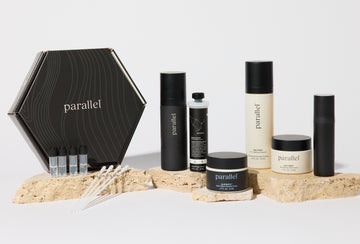
At Parallel Health, our microbiologists and dermatologists built the MD-03 Acne Protocol™ specifically for this. It is a comprehensive, physician-led treatment system that integrates skin microbiome analysis and your hormonal context to design a treatment plan that actually fits your biology, for both women and men navigating acne in midlife.
No broad-spectrum antibiotics as a first resort. No harsh regimens that strip your skin and set off a new round of problems. Compounded prescriptions are formulated in-house and delivered to your doorstep. The MD-03 Acne Protocol™ addresses what is actually driving your breakouts: sebum regulation, microbial restoration, and building the kind of skin resilience that holds up over time.
Frequently Asked Questions
Why is acne showing up now, in my 40s? Hormonal shifts reduce estrogen's counterbalancing effect on androgens in women, and increase DHT sensitivity and alter testosterone-to-estrogen ratios in men. Both changes elevate sebum production and disrupt the skin's microbial ecosystem in ways that drive adult acne.
Does hormonal acne affect men too? Yes, and it is underdiagnosed. Men in their 40s experience hormonal shifts that elevate DHT sensitivity, increase aromatase conversion of testosterone to estrogen, and amplify cortisol-driven sebum production. The result is the same dysbiosis-driven acne, typically presenting along the jawline and back.
Is this the same as teenage acne? No. Adult hormonal acne is deeper, more cystic, and concentrated on the lower face and back. It has a different biological driver and responds to a different treatment approach.
Does diet make a difference? It can. High-glycemic foods and dairy influence insulin and IGF-1 signaling, which affects sebum output. Reducing processed sugar and dairy is a reasonable, evidence-supported first step, but it works best as part of a broader treatment plan rather than a standalone fix.
Does stress make it worse? Yes, meaningfully so. Cortisol stimulates sebaceous gland activity and promotes inflammatory signaling in the skin. Managing stress is worth taking seriously, but stress alone rarely explains the full picture.
What sets the MD-03 Acne Protocol™ apart? It is built around your individual biology, microbiome data, hormonal context, and precision-compounded formulations, rather than a generic prescription handed to everyone who walks in with a breakout.
Scientific References
- Zouboulis, C.C. (2004). Acne and sebaceous gland function. Clinics in Dermatology, 22(5), 360–366.
- Fitz-Gibbon, S., et al. (2013). Propionibacterium acnes strain populations in the human skin microbiome associated with acne. Journal of Investigative Dermatology, 133(9), 2152–2160.
- Thiboutot, D., et al. (2003). Androgens and acne. In Androgen Excess Disorders in Women. Humana Press.
- Grice, E.A., & Segre, J.A. (2011). The skin microbiome. Nature Reviews Microbiology, 9(4), 244–253.
- Smith, R.N., et al. (2007). The effect of a high-protein, low glycemic-load diet versus a conventional, high glycemic-load diet on biochemical parameters associated with acne vulgaris. Journal of the American Academy of Dermatology, 57(2), 247–256.
- Pappas, A. (2009). The relationship of diet and acne: a review. Dermato-Endocrinology, 1(5), 262–267.